

Product Overview

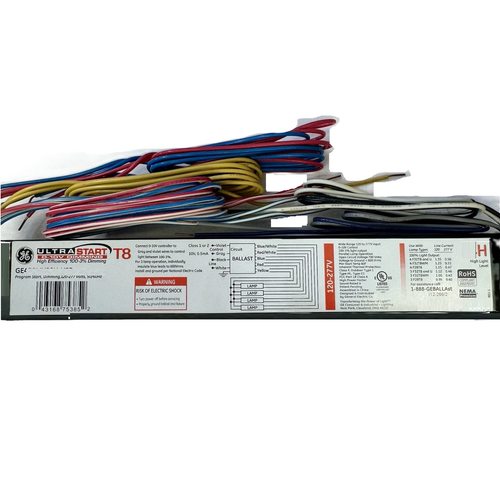
GE 75953 GE132-MVPS-N T8 Electronic Ballast - 1 Lamp F32T8 120–277V Programmed start
The GE 75953 GE132-MVPS-N T8 Electronic Ballast - 1 Lamp F32T8 120–277V Programmed start is a GE electronic fluorescent ballast designed for commercial T8 lighting systems. It is used to operate 1 F32T8 lamp configuration with 120–277V input and Programmed start operation.
This ballast should be selected by matching the GE order code, lamp count, lamp type, ballast factor, input voltage, wiring diagram, and case dimensions to the existing ballast or fixture label.
|
Lamps
1
Supported
|
Voltage
120–277V
Input
|
Start Type
Programmed start
T8 Ballast
|
BF
.88
Ballast Factor
|
Lamp
F32T8
Primary
|
Product Overview
GE T8 electronic ballasts are designed for high-frequency fluorescent operation, quieter performance than older magnetic ballasts, and efficient operation in office, retail, school, healthcare, warehouse, and commercial retrofit applications.
Ballast factor matters: lower ballast factors reduce light output and energy use, normal ballast factors balance output and efficiency, and high ballast factors increase light output where more illumination is needed.
Technical Specifications
| Brand | GE Lighting |
| GE Order Code | 75953 |
| Model | GE132-MVPS-N |
| Product Series | UltraStart / Programmed Start |
| Ballast Type | Electronic - Program/ Rapid Start |
| Starting Method | Programmed start |
| Lamp Wiring | Parallel |
| Input Voltage | 120–277V |
| Supply Frequency | 50Hz Yellow 47.0 in (1194 mm) |
| Number of Lamps | 1 |
| Primary Lamp Type | F32T8 |
| Ballast Factor | .88 |
| Sound Rating | A (20-24 decibels) |
| Power Factor Correction | Active |
| Ambient Temperature Max | Height (H) 1.18 in (30 mm) |
| Case Temperature Max | 70 °C (158 °F) |
| Dimensions | L 9.5 in (241 mm) x W 1.3 in (43 mm) x H 1.18 in (30 mm) |
| Weight | 1.65 lbs |
| Exit Type | Side |
Key Features
- Programmed-start operation helps extend lamp life in frequently switched or sensor-controlled areas.
- Multi-voltage input supports 120V through 277V electrical systems.
- Anti-striation control helps reduce visible lamp spiraling with compatible energy-saving T8 lamps.
- Maximum ambient rating: Height (H) 1.18 in (30 mm).
- Metal enclosure with thermal protection for commercial ballast channels.
Compatible Applications
- Commercial office T8 fluorescent fixtures
- Retail stores, restaurants, schools, and healthcare facilities
- Warehouse, industrial, and maintenance retrofit projects
- Fixture repairs where the GE model and wiring diagram match
- Energy-saving T8 lamp systems when ballast/lamp compatibility is confirmed
Before Ordering Verify
- Exact GE Model: Match GE 75953 / GE132-MVPS-N to the existing ballast label or fixture documentation.
- Lamp Count: Confirm the ballast supports 1 lamp operation.
- Lamp Type: Confirm compatibility with F32T8 and any reduced-wattage lamps being used.
- Input Voltage: Confirm the fixture supply matches 120–277V.
- Starting Method: Match instant-start or programmed-start requirements, especially when occupancy sensors are used.
- Wiring Diagram: Follow the wiring diagram on the ballast label and verify socket type before installation.
- Case Size: Confirm the ballast channel has room for the listed case dimensions.
Safety & Installation Guidelines
- Qualified Installation: Ballasts should be installed by qualified personnel following applicable electrical codes.
- Disconnect Power: Turn off and lock out power before removing or installing a ballast.
- Grounding: Properly ground the ballast and fixture to reduce EMI/RFI and support safe operation.
- Do Not Bundle Leads: Avoid twisting or bundling lamp leads; excess wiring can create starting or performance issues.
- Use Correct Sockets: Programmed-start and dimming systems require rapid-start type sockets.
Wholesale & Project Support
ADL Supply supports contractors, facility managers, maintenance departments, and commercial buyers with GE ballast replacement identification, project quoting, and volume order support.
For volume pricing, availability, or help confirming the correct GE replacement ballast, contact ADL Supply at 1-800-235-3489.